No products in the cart.
MyBioMask research project
MyBioMask research project
MyBioMask: A mask that shows when it's time for a change.
.......................
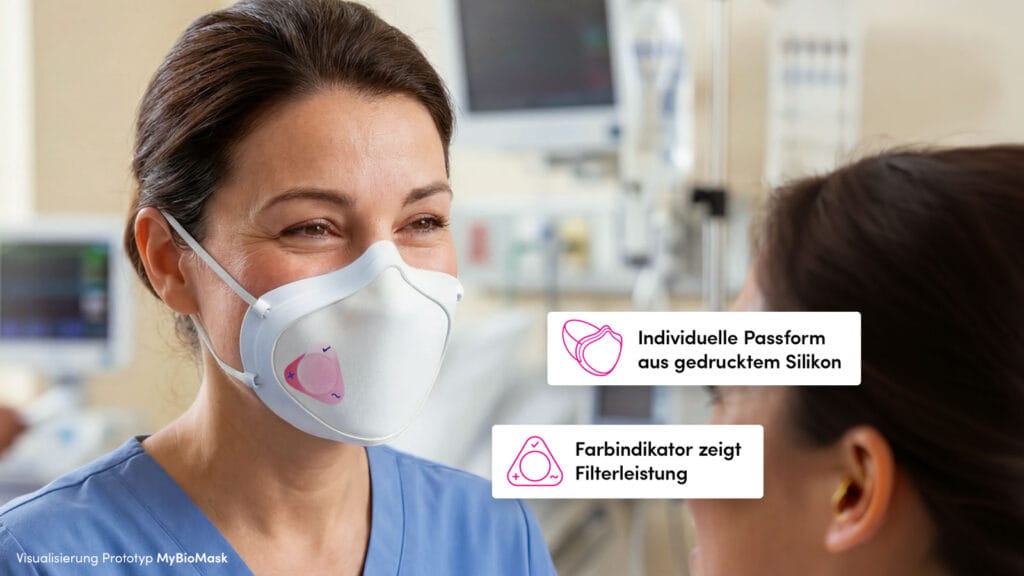
How long does an FFP2 mask really provide reliable protection?
From the outside, a mask often looks almost unchanged even after prolonged use. At the same time, increasing moisture and the seal of the fit determine whether a mask actually provides good protection.
The problem:
Invisible filter loss
FFP2 masks protect through electrostatically charged fibers that attract and trap particles. As moisture increases from breathing, the electrical charge, and therefore the filter's effectiveness, can decrease. The point at which this point is reached remains invisible to the person carrying the load.
Poor fit
Standard mask geometries only fit some of the different face shapes. This can lead to leaks at the mask edge, where unfiltered air flows in and out. At the same time, a poorly fitting mask can reduce wearing comfort. This can reduce both the protective effect and the willingness to wear it regularly in everyday life.
How about a mask that reduces uncertainty?
It adapts as closely as possible to the individual face – and a color indicator shows how far its use has progressed.
This is precisely the scenario we are working on together with our project partners in the research project. MyBioMask.
The current results and a visualization of the prototype were presented at Thuringian Materials Day 2026 „Smart Materials, Smarter Sensors“ presented in a poster presentation:
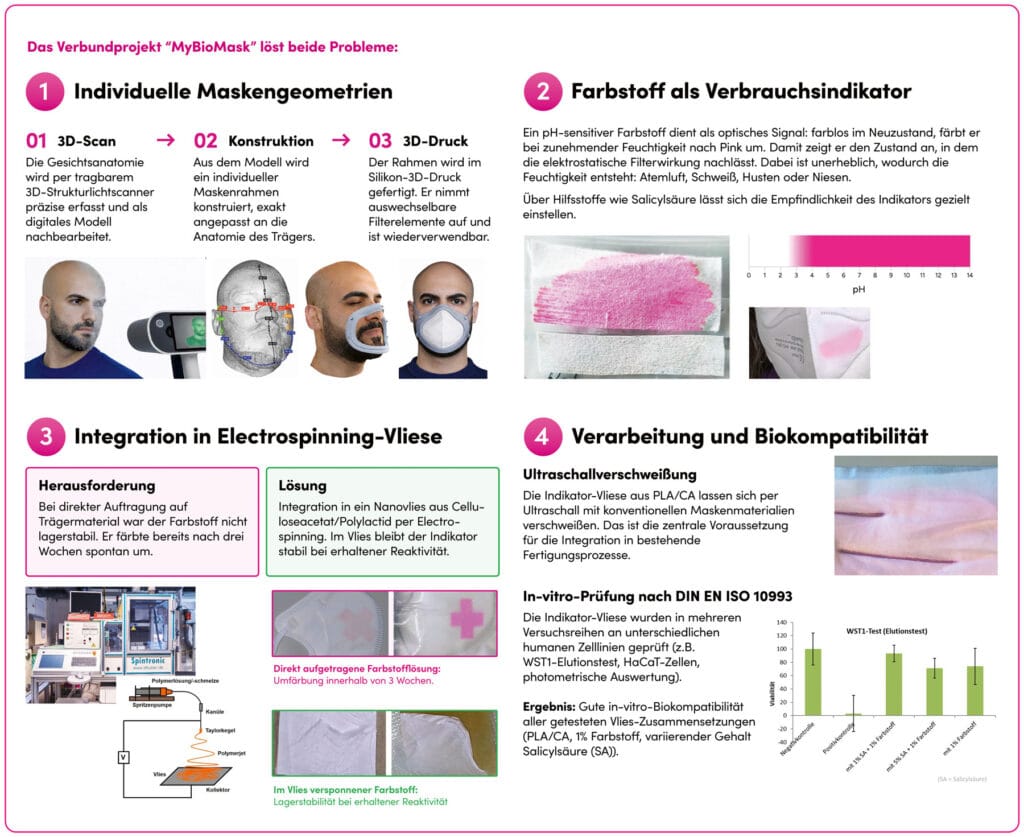
The dye system indicates the state
Our contribution to Heyfair is this Dye system as a sensory marker of the mask.
The idea behind it sounds simple at first: A dye is integrated into the mask and gradually changes color under the conditions of being worn. A decrease in the filter's effectiveness is thus visible as a visual signal.
In practice, however, this is considerably more challenging. The dye must remain stable during storage and transport, react reliably under the conditions inside a worn mask, and must not migrate uncontrollably into other material layers.
In short: The dye must be reactive – but not react at the precise moment it shouldn't.
From dye to sensory fleece
Therefore, we tested various dyes and reaction mechanisms – and quickly realized: What works in the lab cannot automatically be transferred to a multi-layered FFP2 mask. Some systems reacted too quickly, others were not stable enough.
There is also a second challenge: The dye must be reliably integrated into the filter material. Here our project partner brings INNOVENT eV. He contributes his expertise in electrospinning. Together, they are investigating how the dye can be embedded in the extremely fine fibers of a sensory nonwoven fabric without losing its reactivity or being washed out of the material.
A particularly suitable dye candidate has now been identified. A color change is already evident under natural respiration, and its intensity is currently being further optimized. In parallel, the sensory fleeces developed from this dye are being tested for stability and biocompatibility.
A good mask must also fit well.
The second major component of MyBioMask concerns the Fit.
Faces are different – standardized mask geometries can only partially accommodate this diversity. Even small leaks at the mask's edge can cause exhaled air to bypass the filter material. At the same time, a mask should not only fit tightly but also be comfortable to wear for extended periods.
On Jena University Hospital Therefore, 3D facial scans are created and individually adapted mask bodies are developed from them. The goal is a geometry that fits the respective face shape as precisely as possible, thus combining a tight fit with wearing comfort.
Thorey Gera Textile Finishing GmbH The consortium will take over project coordination and is tasked with technically transferring the developed solutions into industrial mask production.
Many skills for a common goal
In order for this idea to become a functioning overall system, different specialist fields are intertwined in the collaborative project.
The video shows the collaborative work on the project.
This research project is funded by:
Network partners:

The FTI research project „MyBioMask – Development of individualized sustainable filter materials with indicator systems“ runs from January 1, 2024 to December 31, 2026.
Heyfair works together with INNOVENT eV, the University Hospital Jena and the Thorey Gera Textile Finishing GmbH.
Joint project no.: 1000479
Subject of funding: 2023 VFE 0054 – Research and Development Project Thuringia Network
Funding period: 01.01.2024–31.12.2026
Co-financed by the European Union
Posted by Heyfair | August 2026
Find out more?
Recent posts
.......................
Try it out!
Now your free
Request a sample!
We send free trial packs to professionals and companies. See for yourself and order your first training with DesiCoach® here.
Request sample.......................
Network:
Follow us on social media!
.......................
Write us your opinion or questions in the comments:

Still have questions?
We’re happy to help.
.....................
Whether it's about our products, shipping, delivery options, or hygiene training: Our team will help you in a friendly and competent manner. Just call or send us an email.
 Deutsch
 English
 Italiano
 Français
 Nederlands
 Polski